|
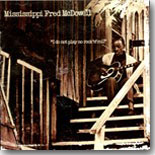
Mississippi Fred McDowell
I Do Not Play No Rock 'n' Roll
Fuel 2000 |
 Even though
Mississippi Fred McDowell didn't
record until 1959, when he was in his
mid-50s, he had been playing guitar since he
was 14 years old. Born in Rossville, Tennessee, he
didn't move to Mississippi until he was in his
mid-20s. He worked as a farmer full-time,
playing music on the weekends for picnics,
festivals, and dances.
Even though
Mississippi Fred McDowell didn't
record until 1959, when he was in his
mid-50s, he had been playing guitar since he
was 14 years old. Born in Rossville, Tennessee, he
didn't move to Mississippi until he was in his
mid-20s. He worked as a farmer full-time,
playing music on the weekends for picnics,
festivals, and dances.
He was first recorded by
the musicologists Alan Lomax and Shirley Collins
as part of their Southern Journey
field-recordings, attracting
the attention of blues fans.
McDowell initially recorded for Arhoolie and
Testament Records, and his slide guitar and
driving, rhythmic, sometimes hypnotic playing
was breathtaking. Because his sound was
virtually unchanged over the 30-plus years
that he had played (he was younger than Son
House and Skip James, but a few years older than
Robert Johnson), it was like hearing those early
blues that most listeners had only been able to
hear previously on scratchy 78s. He became a bit
of a celebrity, appearing at various blues and
folk music festivals in the United States and
Europe.
In 1969 he was signed to Capitol Records to
record an album, a move that guaranteed him the
potential for a larger audience than his
previous releases on independent labels.
He
arrived at Malaco Records in Jackson, Mississippi
sporting an electric guitar for the very first time, a move
which alarmed the blues purists, maybe as much as Dylan shocked
the folk purists when he plugged in at Newport a few years
earlier. He also incorporated a rhythm section for the first
time. Malaco session guitarist
Jerry Puckett played bass and Dulin Lancaster
played drums.
It all worked out just fine for this
album, I Do Not Play No Rock 'n' Roll. The
original LP consisted of nine tracks, the
expanded CD from Fuel 2000 issued in 2001 adds
five other cuts, equally as intense and powerful
as the original set.
On the opening track,
McDowell introduces himself leading into a
cover of Big Joe Williams' “Baby Please Don't
Go,” with the description of his playing style
including the statement that serves as the album
title.
His stinging, clear bottleneck style is amazing,
the slide often echoing or answering his vocals.
Anyone who hears McDowell electrified will
wonder why he played unplugged. The
much-lamented rhythm section is well into the
background, so the focus is completely on
McDowell throughout the album.
Most of the tracks will be familiar to McDowell
followers or Delta blues fans, such as “Good Morning
Little School Girl,” “Kokomo Me Baby,” “Red
Cross Store,” maybe my favorite versions of “61
Highway,” and “Jesus Is On The Mainline.”
Other
tracks include “That's All Right Baby,” and
“Everybody's Down On Me,” a fascinating
nine-minute track, four minutes of which is
McDowell ruminating on the blues itself.
The bonus tracks include “My Baby She Gonna Jump
And Shout,” “Long Line Skinner,” “You Got To
Move” (another McDowell classic), “The Train I
Ride” (McDowell's version of Junior Parker's
“Mystery Train”), and “You Ain't Gonna Worry My
Life No More.” The last three songs feature just McDowell
and his guitar, and they are just as moving as the
previous songs.
No blues fan's collection is complete without at
least one Mississippi Fred McDowell album,
especially any fans of the North Mississippi
Hill Country sound, all of which can be traced
right back to the old guitarist from Como, Mississippi.
Bonnie Raitt and the Rolling Stones were also
influenced by his music and covered several of
his songs.
McDowell passed away in July of 1972
after a short battle with cancer. I Do Not Play
No Rock 'n' Roll serves as a fine introduction
to his music, but please also check out those
equally wonderful Arhoolie and Testament
recordings.
--- Graham Clarke