|
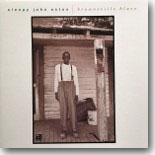
Sleepy
John Estes
Brownsville Blues
Delmark Records |
 Several years ago I was in Tunica,
Mississippi at a
convention, and I traveled over to what was then
the Bluesland Casino, where they had a pretty
cool blues museum. It was set up with old
records, old guitars and other memorabilia.
Several years ago I was in Tunica,
Mississippi at a
convention, and I traveled over to what was then
the Bluesland Casino, where they had a pretty
cool blues museum. It was set up with old
records, old guitars and other memorabilia.
While I was in there looking around, another man
came in and we ended up looking at the same
guitar on display, which belonged to Sleepy John
Estes. Turns out this man was a relative of
Estes' and we had a nice conversation about him,
encouraging me to dig deeper into his
music.
I had heard several songs written by Estes that
were performed by other artists, such as Eric
Clapton, Gregg Allman, Taj Mahal, Johnny Winter,
North Mississippi Allstars, Derek Trucks,
Fleetwood Mac, Big Joe Williams, Honeyboy
Edwards, and many others, but I'd never really
listened to his own music.
I reviewed a live set
from Delmark
here, but it
wasn't until a couple of years ago that I really
started listening to his music, going back to
his earliest recordings in 1929. In those early
days, Estes often played with harmonica player Hammie Nixon and mandolinist Yank Rachell,
recording until the early 1940s.
He was largely out of the public eye for most of
the '40s and '50, other than a pair of tunes
recorded for Sun Records in 1952, and many
people thought that he had passed away. Big Bill Broonzy reported that Estes was “87 years old”
when he wrote Big Bill Blues in 1955, but he was
actually born in 1899 or 1900.
Big Joe Williams
and Memphis Slim began to let people know that
Estes was still alive and living where he'd always
lived in Brownsville, Tennessee. He was tracked down
by Delmark Records head Bob Koester and Samuel
Charters in 1962, and when they found him he was
completely blind and in poverty.
Delmark recorded and released several albums by
Estes in the '60s. In 1964, they released
Brownsville Blues, which is a great
representation of just what Sleepy John Estes
was all about. Broonzy called Estes' singing
style “crying the blues” because of it's
emotional quality, but he learned it when he was
working as a leader on a railroad crew.
That
style remained intact. In his earlier recordings he was an
average guitarist, but his guitar playing
improved after he lost his sight because he was
able to focus more on his playing.
Brownsville Blues focuses primarily on the
people and places of Estes' hometown, with songs
like “Al Rawls,' a funeral home owner who acted
as intermediary for Estes with his Delmark
contract, “Vassie Williams,” a mechanic who
didn't have a shop so he had to work on cars on
the side of the road, “Mary Come On Home,”
“Martha Hardin,” and “Pat Mann,” about the
proprietor of a Brownsville store, and “Young
Lawyer,” about the son of the store owner.
Other
songs related to his hometown are “Lawyer
Clark,” “City Hall Blues,” “Government Money,
and “Working Man Blues,” which reflect changes
to Estes' way of life.
Accompanying Estes on selected tracks are Nixon
(harmonica) and Rachell (guitar), along with Ed
Wilkenson and Ransom Knowling (bass). The CD
release of the album in the early '90s also
included six other previously unissued songs.
One of those is a new version of “Drop Down
Mama,” and another is the poignant “I'd Been
Well Warned,” on which Estes laments not doing
what he needed to do to help keep his eyesight.
Estes performed and recorded frequently after
his rediscovery, often with Rachell and Nixon,
but had a stroke while getting ready to go on a
European tour and died on June 5, 1977 in
Brownsville. He was still in poverty at his
death, despite his renewed fame and popularity
among many musicians, including Robert Plant,
Bob Dylan, and the Beatles, who all cited Estes
as influences.
Brownsville Blues is a fine capsule summary of
what Sleepy John Estes was about --- his highly
intimate and personal songwriting and his
distinctive, keening vocal style that stays with
you long after listening. This is a fine place
to get on board with Estes' music, and it should
encourage listeners to keep digging into his
catalog.
--- Graham Clarke